Political Parties in Britain 1783-1867 by Evans Eric J
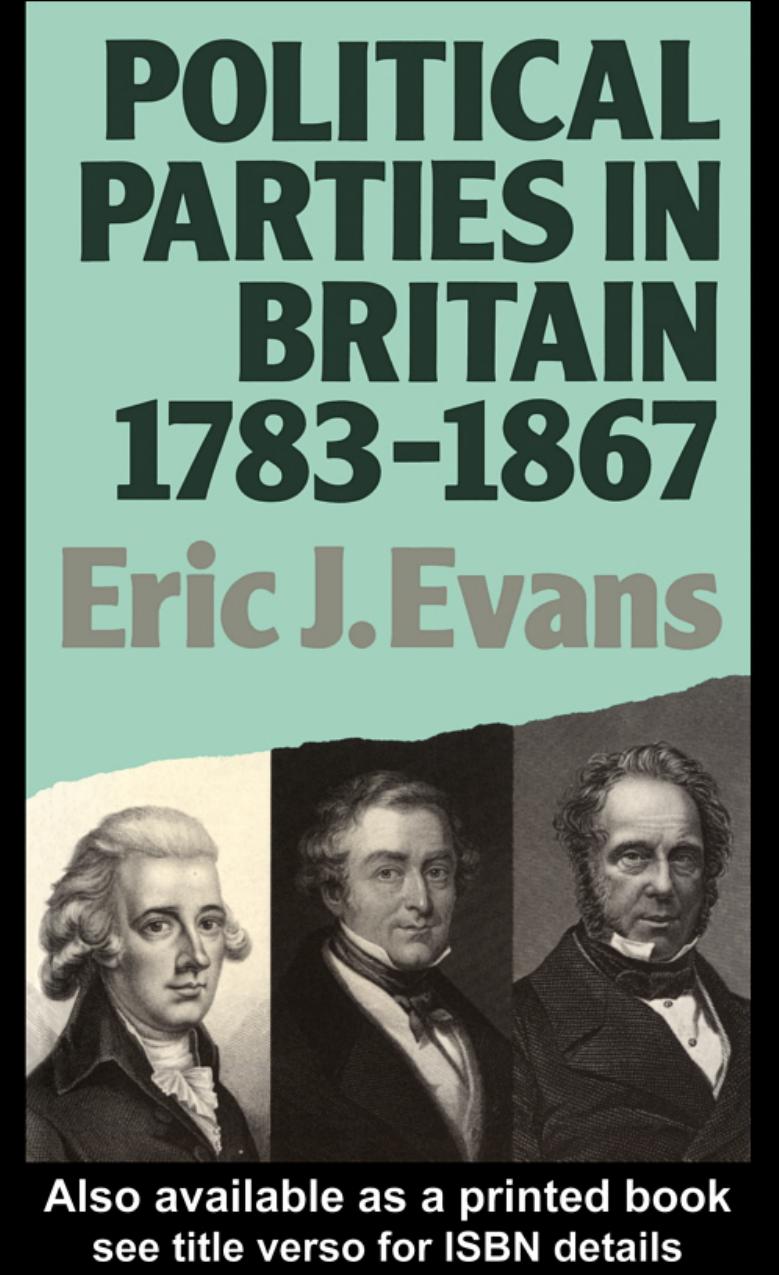
Author:Evans, Eric J.
Language: eng
Format: epub, pdf
Publisher: Taylor & Francis (CAM)
Published: 2011-10-09T16:00:00+00:00
The establishment of two-party politics, 1832–46
One historian has argued that ‘The essential ingredients of the British two-party system had . . . not only appeared but had been largely accepted both by politicians and by public opinion by 1832’ (4). It is a tempting thesis. We have seen ample evidence of politicians at Westminster thinking on increasingly two-party lines after 1794. Though party allegiances were in total confusion, especially on the Tory side, between 1827 and 1832, the polarizing power of religion and parliamentary reform virtually removed the independent MP as a separate factor in Westminster politics. After 1832, almost all politicians adopted party labels when they stood for election. The evident collapse of the power of the crown further reduced the possibilities of alternative allegiance.
We must be cautious about accepting this thesis, however. Party organization and party discipline alike were much increased only after 1832, as we shall see. In the Reform Act crisis itself, furthermore, politicians readily moved between parties. Such movement was much more painful and much more protracted after 1846 (see page). Between 1828 and 1832 the Canningites effectively became Whigs and their most able lieutenant, Viscount Palmerston, was installed as Grey’s foreign secretary. Tory party allegiance at the same time became much more fluid. Peel remained in open dispute with the ‘Ultras’ who made up the bulk of the Tory group after the 1832 election. Gash believes that in 1832 there ‘was no acknowledged head and no real party’.
The election of 1832 was not properly between Whigs and Tories. Rather, it was fought between those who supported, and those who had opposed, the principle of parliamentary reform. The former, much larger, category included about fifty moderate reformers who saw the necessity for reform in 1832 to avert revolution but who were firm opponents of radicalism and staunch adherents of the Church of England. At the other pole were about one hundred variegated and disunited radical reformers who included democrats, republicans, free traders and advocates of the disestablishment of the Church of England. In 1832–3 many of these radicals opposed ministerialist reformers, the main props of Grey’s government, at least as often as they supported them.
From this confusion a closer two-party alignment than ever was visible by the end of 1835. In June 1834 the Whigs were weakened by the resignation from the Cabinet of two firm Church of England men, Sir James Graham and Lord Stanley, on the divisive issue of ‘appropriation’. This entailed drawing off surplus revenue owned by the Anglican church in Ireland and diverting it to non-religious purposes such as educational and social reforms. Appropriation was widely interpreted among moderates and Tories as an attack on the Church. Their feeling of unease was strengthened in July when Grey resigned as prime minister, to be replaced by Melbourne. Melbourne was no radical, but Irish MPs who followed O’Connell and were enthusiastic advocates of appropriation used the change of government to move closer to the Whigs in the hope of pushing the measure through. More MPs began to see why Graham and Stanley had resigned.
Download
Political Parties in Britain 1783-1867 by Evans Eric J.pdf
This site does not store any files on its server. We only index and link to content provided by other sites. Please contact the content providers to delete copyright contents if any and email us, we'll remove relevant links or contents immediately.
| Anthropology | Archaeology |
| Philosophy | Politics & Government |
| Social Sciences | Sociology |
| Women's Studies |
The Secret History by Donna Tartt(19466)
The Social Justice Warrior Handbook by Lisa De Pasquale(12292)
Thirteen Reasons Why by Jay Asher(9115)
This Is How You Lose Her by Junot Diaz(7054)
Weapons of Math Destruction by Cathy O'Neil(6465)
Zero to One by Peter Thiel(5946)
Beartown by Fredrik Backman(5930)
The Myth of the Strong Leader by Archie Brown(5623)
The Fire Next Time by James Baldwin(5579)
How Democracies Die by Steven Levitsky & Daniel Ziblatt(5321)
Promise Me, Dad by Joe Biden(5228)
Stone's Rules by Roger Stone(5185)
A Higher Loyalty: Truth, Lies, and Leadership by James Comey(5082)
100 Deadly Skills by Clint Emerson(5023)
Rise and Kill First by Ronen Bergman(4890)
Secrecy World by Jake Bernstein(4873)
The David Icke Guide to the Global Conspiracy (and how to end it) by David Icke(4845)
The Doomsday Machine by Daniel Ellsberg(4618)
The Farm by Tom Rob Smith(4608)
